
Why Sticker Charts Do Not Work
And What the Nervous System Actually Needs Instead
If you have ever stood in a craft store buying star stickers with genuine hope, this post is for you.
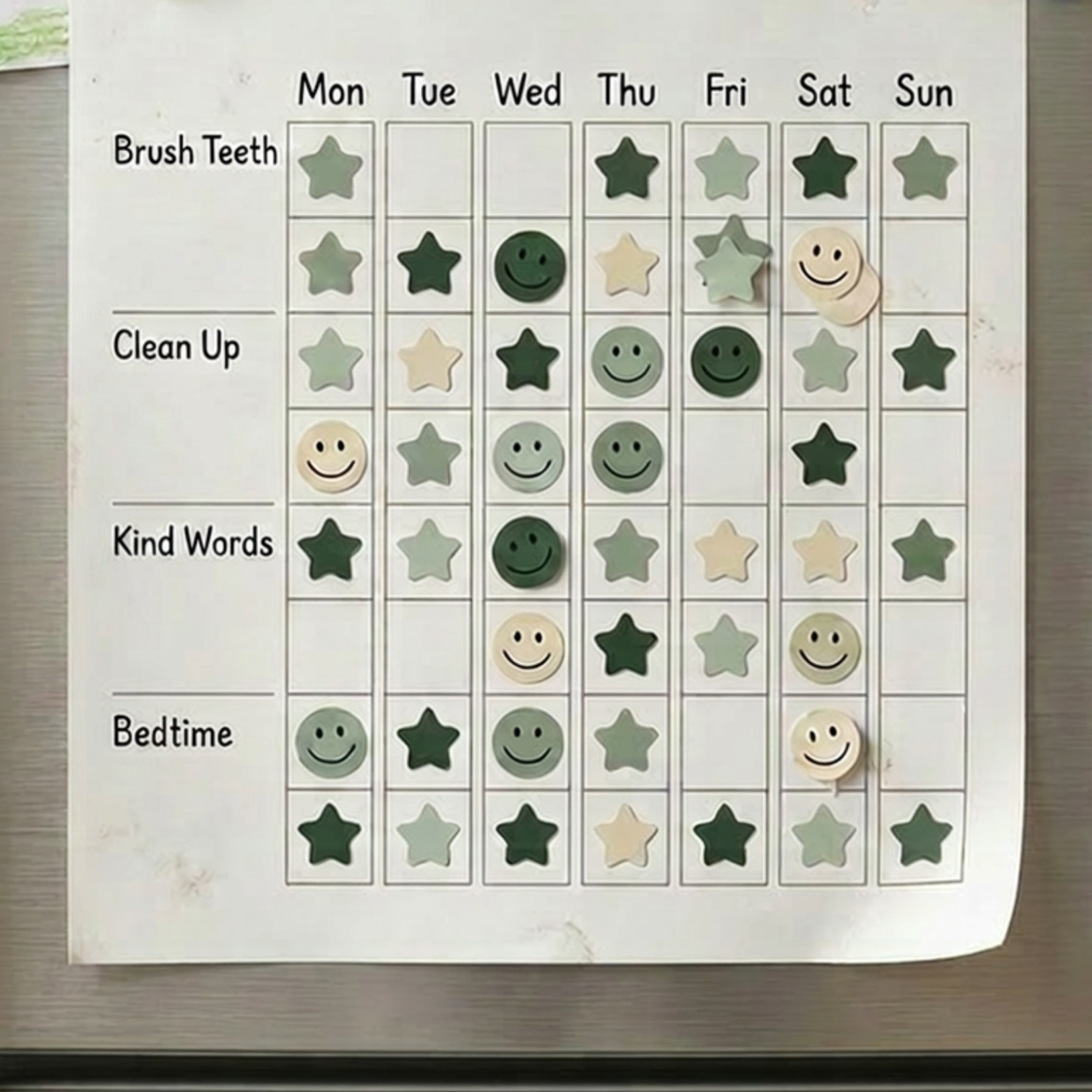
Sticker charts are one of the most universally recommended behavior tools in early childhood, recommended by pediatricians, teachers, parenting books, and well-meaning relatives. They are tidy and visual and they feel like doing something. For a few days, they often even work.
And then they do not.
By day six or seven, the sticker loses its power. The child who was enthusiastically earning stars is now asking what is the point, or demanding a bigger reward, or ignoring the chart entirely, and the parent is left wondering what they did wrong.
They did not do anything wrong. The tool was built for a different problem than the one they were trying to solve.
What Sticker Charts Are Actually Doing
Sticker charts are a form of extrinsic motivation, an external reward layered on top of a desired behavior. Modern behavioral research is consistent on this point: external rewards work in the short term for simple, rote tasks. They do not build intrinsic motivation. In many cases, they actively work against it.
Ancestral parenting wisdom arrived at the same conclusion long before it had a research citation. Across generations and cultures, children were rarely raised on token economies. They were raised inside relationship, learning to behave well because they were held well, not because a star was waiting on the other side of it.
When a child earns a sticker for sharing, the brain begins to associate sharing with reward, not with the natural feeling of connection and generosity sharing produces. Over time, the child does not share more. They share when there is a sticker. Remove the sticker, remove the behavior.
More critically for our purposes: sticker charts were never designed to address emotional regulation. This is where polyvagal theory becomes useful. When a child is in a threat state, flooded, activated, in the middle of a meltdown, the nervous system has shifted out of its safe, socially engaged mode and into pure survival. The reward-processing part of the brain is offline. The sticker chart is invisible to a nervous system that needs regulating. It is only visible to a nervous system that is already calm enough to want one.
You cannot reward a nervous system into regulation. It does not speak the language of stickers. It speaks the language of safety, the same language it has spoken since long before charts and stars existed.
The Deeper Problem With Reward-Based Emotional Tools
When we give a child a sticker for calming down, we are, without intending to, teaching them something specific: that the goal of a hard feeling is to stop having it as quickly as possible.
This is not emotional literacy. It is emotional suppression wearing a reward's clothing.
Emotional literacy, the capacity to recognize, name, tolerate, and eventually move through emotional states, is built through experience. Through having a feeling and surviving it. Through having an attuned adult witness the feeling without trying to erase it. Through learning, over hundreds of small moments, that emotions are information, not emergencies.
A sticker chart skips all of that. It trains the child toward suppression, not regulation. Unfelt emotions do not disappear. The body holds what the mind was asked to hurry past, and it tends to surface later, louder.
This is why children raised on reward systems for emotional behavior so often become teenagers who have no idea what they feel or why. The map was never built.
What Intrinsic Motivation Actually Looks Like
The goal is not obedient behavior. The goal is a child who can feel something hard, tolerate it, and make a deliberate choice about how to respond, because that skill is genuinely theirs, not borrowed from a sticker system.
That capacity is built through exactly what you might expect: repeated experience of the process, with a regulated adult who stays present through it. Not a reward on the other side of it. The process itself.
HeartMath research on heart-brain coherence shows something remarkable here: a child's nervous system entrains to the regulated adult nearby. When a child moves through a hard feeling, really moves through it, with a steady adult close, the nervous system logs the experience. It files: I was overwhelmed. I survived. The adult stayed. I came back. That filing, repeated, is the foundation of self-regulation. It cannot be shortcut, and it makes calm more possible next time. Not guaranteed. More possible.
What to Use Instead
This is not an argument against structure, consistency, or positive reinforcement in general. Those things have genuine value in a child's developmental environment. The specific argument is against using reward systems to manage emotional states, because they are addressing the wrong level of the problem.
Here is what actually builds regulation over time.
Co-regulation first, always. Before any tool, technique, or intervention: your regulated nervous system. Get regulated yourself first, then get close.
Name the feeling without an agenda. "I can see you are really frustrated right now" is not the same as "Use your words." One witnesses. One demands. The nervous system can only receive the first one.
Narrate the wave. "This feeling is really big. It is okay. It is going to move through." Buddhist teaching has held this truth for centuries: all things, including feelings, are impermanent. Children do not know that yet. Naming the arc out loud is how they learn it.
Teach skills in green, not red. When the child is calm, genuinely calm, not suppressed, that is when you practice breathing, body check-ins, tapping, or any other regulation tool. The red-state brain cannot take in a lesson. The green-state brain can.
Connect the feeling to the body. "Where do you feel that in your body?" Somatic traditions have asked some version of this question for thousands of years, long before it had a clinical name. It is the beginning of recognizing an emotional state before it becomes a full activation, and it is one of the most important skills a child can develop.
A Note on Praise
Praise deserves a mention here because it lives adjacent to the sticker chart conversation and carries some of the same risk.
Evaluative praise, statements like "you are so good" or "you are so smart," has been shown to make children more fragile around failure, not less. When identity is tied to outcome, failure becomes a threat to the self.
Descriptive acknowledgment lands differently. "I noticed you stayed in your seat even when it was hard" names the specific effort without attaching it to a global identity. The child can own the effort. They cannot own being "good," because good is external and revocable.
The shift is small. The impact over time is not.
What This Asks of Us as Adults
The honest reason sticker charts are so popular is not that they are the best tool. It is that they give the adult something to do. They offer a feeling of agency in a moment that often feels completely out of control.
In my years teaching kindergarten and first grade, before I had my own twin boys, I watched dozens of thoughtfully laminated charts end up exactly where this one will: in a drawer, unused, by week two.
What the nervous system actually needs from us is presence, attunement, and regulated co-existence through a hard feeling. It asks us to tolerate our own discomfort without reaching for a fix. That is genuinely hard, especially when we are depleted, especially in public, especially when the noise and the chaos feel like they are reflecting something back at us about our adequacy as parents.
They are not. A child in a hard feeling is not evidence of a failing parent. It is evidence of a developing nervous system doing the work it is meant to do, needing, as it has always needed, a regulated adult beside it.
Want to go deeper?
You Are the Intervention is the complete co-regulation guide for parents and educators, covering brain states, behavior as communication, scripts for hard moments, and the adult tools that make it all possible. Available now at neraliwell.com.
Where parent healing and child development finally happen at the same time.
neraliwell.com · @neraliwell
