
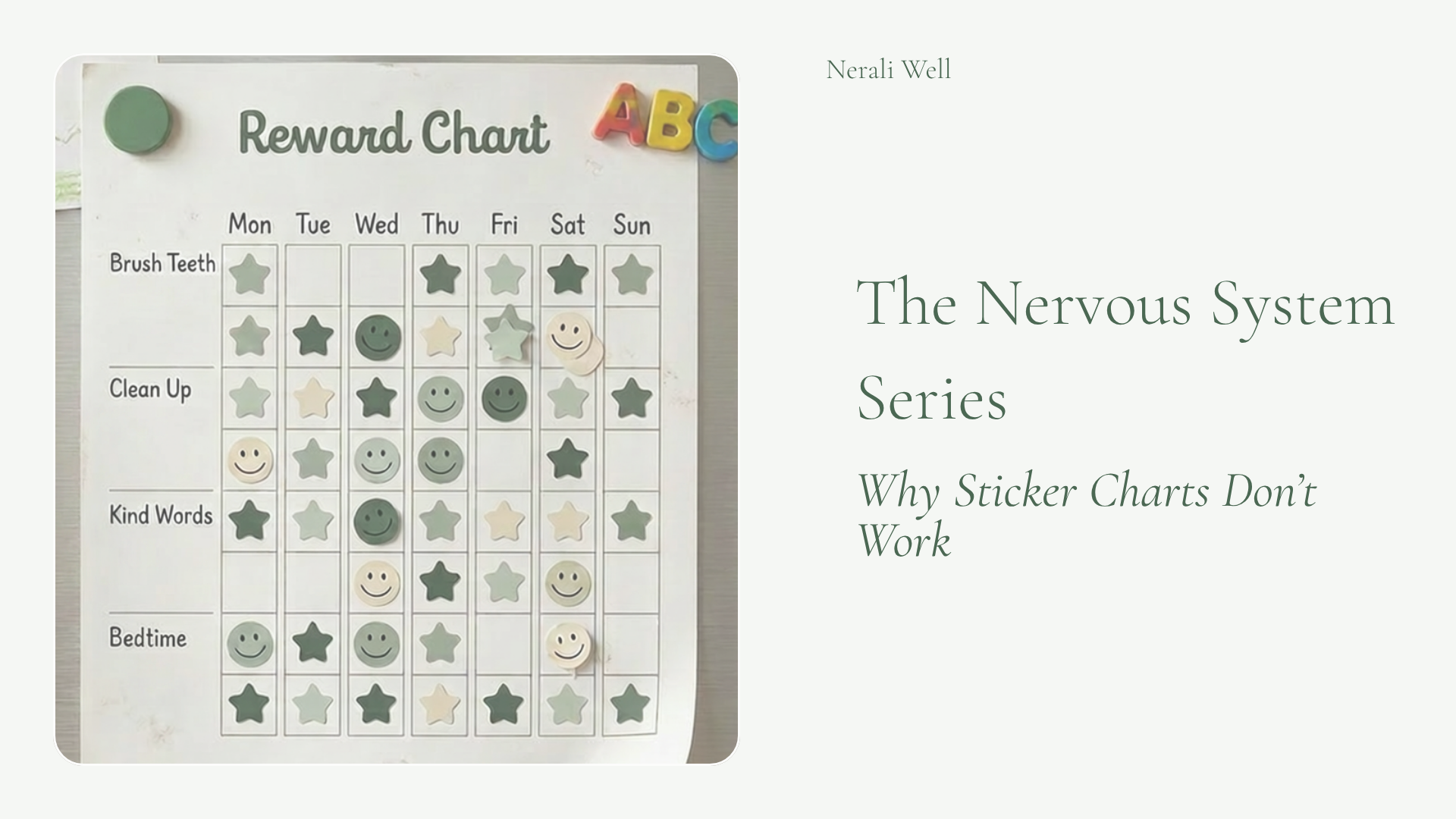
Sticker charts work for about five days and then they don't. Here's the neuroscience behind why reward systems fail for emotional regulation, and what the nervous system actually need.
Why Sticker Charts Do Not Work
And What the Nervous System Actually Needs Instead
If you have ever stood in a craft store buying star stickers with genuine hope, this post is for you.
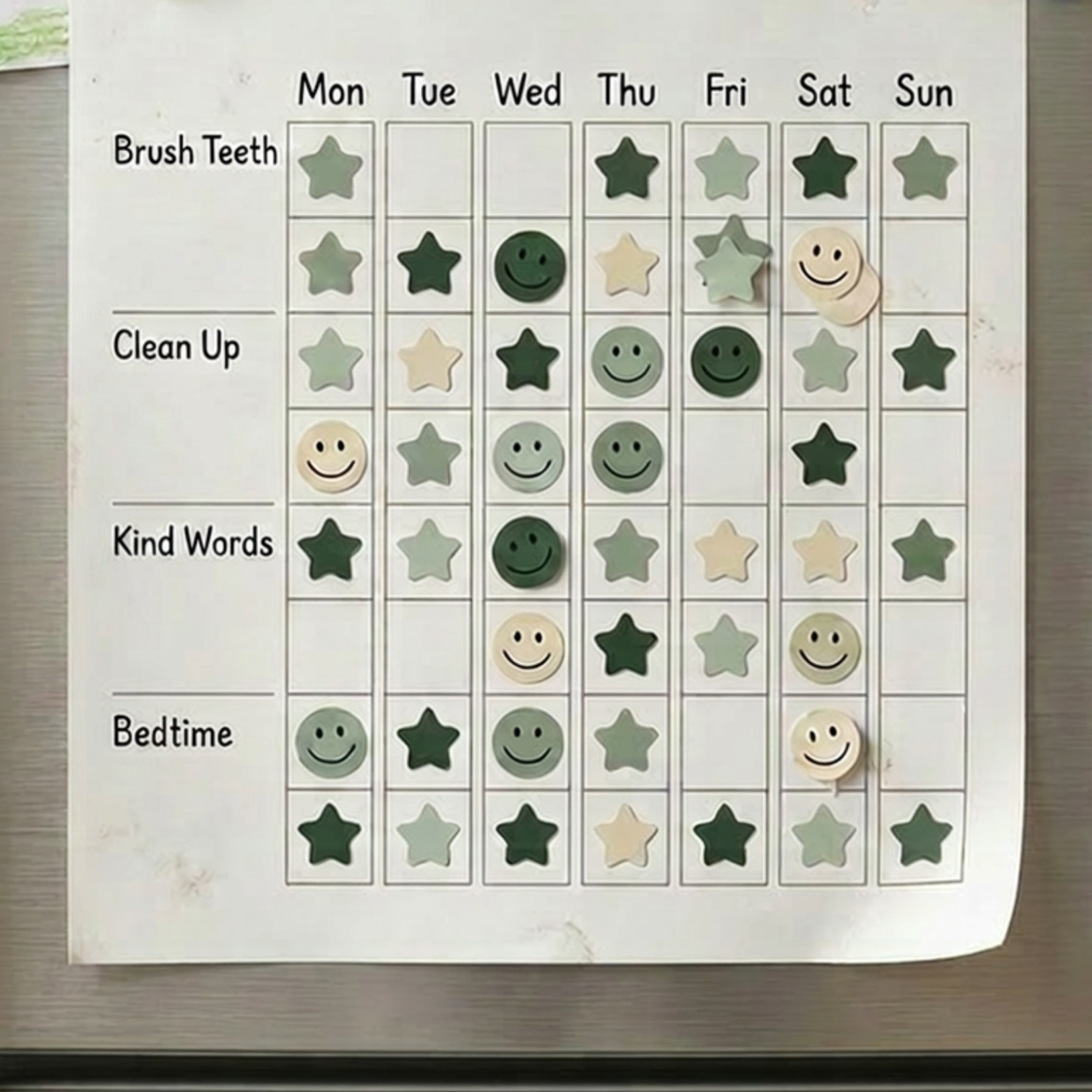
Sticker charts are one of the most universally recommended behavior tools in early childhood, recommended by pediatricians, teachers, parenting books, and well-meaning relatives. They are tidy and visual and they feel like doing something. For a few days, they often even work.
And then they do not.
By day six or seven, the sticker loses its power. The child who was enthusiastically earning stars is now asking what is the point, or demanding a bigger reward, or ignoring the chart entirely, and the parent is left wondering what they did wrong.
They did not do anything wrong. The tool was built for a different problem than the one they were trying to solve.
What Sticker Charts Are Actually Doing
Sticker charts are a form of extrinsic motivation, an external reward layered on top of a desired behavior. Modern behavioral research is consistent on this point: external rewards work in the short term for simple, rote tasks. They do not build intrinsic motivation. In many cases, they actively work against it.
Ancestral parenting wisdom arrived at the same conclusion long before it had a research citation. Across generations and cultures, children were rarely raised on token economies. They were raised inside relationship, learning to behave well because they were held well, not because a star was waiting on the other side of it.
When a child earns a sticker for sharing, the brain begins to associate sharing with reward, not with the natural feeling of connection and generosity sharing produces. Over time, the child does not share more. They share when there is a sticker. Remove the sticker, remove the behavior.
More critically for our purposes: sticker charts were never designed to address emotional regulation. This is where polyvagal theory becomes useful. When a child is in a threat state, flooded, activated, in the middle of a meltdown, the nervous system has shifted out of its safe, socially engaged mode and into pure survival. The reward-processing part of the brain is offline. The sticker chart is invisible to a nervous system that needs regulating. It is only visible to a nervous system that is already calm enough to want one.
You cannot reward a nervous system into regulation. It does not speak the language of stickers. It speaks the language of safety, the same language it has spoken since long before charts and stars existed.
The Deeper Problem With Reward-Based Emotional Tools
When we give a child a sticker for calming down, we are, without intending to, teaching them something specific: that the goal of a hard feeling is to stop having it as quickly as possible.
This is not emotional literacy. It is emotional suppression wearing a reward's clothing.
Emotional literacy, the capacity to recognize, name, tolerate, and eventually move through emotional states, is built through experience. Through having a feeling and surviving it. Through having an attuned adult witness the feeling without trying to erase it. Through learning, over hundreds of small moments, that emotions are information, not emergencies.
A sticker chart skips all of that. It trains the child toward suppression, not regulation. Unfelt emotions do not disappear. The body holds what the mind was asked to hurry past, and it tends to surface later, louder.
This is why children raised on reward systems for emotional behavior so often become teenagers who have no idea what they feel or why. The map was never built.
What Intrinsic Motivation Actually Looks Like
The goal is not obedient behavior. The goal is a child who can feel something hard, tolerate it, and make a deliberate choice about how to respond, because that skill is genuinely theirs, not borrowed from a sticker system.
That capacity is built through exactly what you might expect: repeated experience of the process, with a regulated adult who stays present through it. Not a reward on the other side of it. The process itself.
HeartMath research on heart-brain coherence shows something remarkable here: a child's nervous system entrains to the regulated adult nearby. When a child moves through a hard feeling, really moves through it, with a steady adult close, the nervous system logs the experience. It files: I was overwhelmed. I survived. The adult stayed. I came back. That filing, repeated, is the foundation of self-regulation. It cannot be shortcut, and it makes calm more possible next time. Not guaranteed. More possible.
What to Use Instead
This is not an argument against structure, consistency, or positive reinforcement in general. Those things have genuine value in a child's developmental environment. The specific argument is against using reward systems to manage emotional states, because they are addressing the wrong level of the problem.
Here is what actually builds regulation over time.
Co-regulation first, always. Before any tool, technique, or intervention: your regulated nervous system. Get regulated yourself first, then get close.
Name the feeling without an agenda. "I can see you are really frustrated right now" is not the same as "Use your words." One witnesses. One demands. The nervous system can only receive the first one.
Narrate the wave. "This feeling is really big. It is okay. It is going to move through." Buddhist teaching has held this truth for centuries: all things, including feelings, are impermanent. Children do not know that yet. Naming the arc out loud is how they learn it.
Teach skills in green, not red. When the child is calm, genuinely calm, not suppressed, that is when you practice breathing, body check-ins, tapping, or any other regulation tool. The red-state brain cannot take in a lesson. The green-state brain can.
Connect the feeling to the body. "Where do you feel that in your body?" Somatic traditions have asked some version of this question for thousands of years, long before it had a clinical name. It is the beginning of recognizing an emotional state before it becomes a full activation, and it is one of the most important skills a child can develop.
A Note on Praise
Praise deserves a mention here because it lives adjacent to the sticker chart conversation and carries some of the same risk.
Evaluative praise, statements like "you are so good" or "you are so smart," has been shown to make children more fragile around failure, not less. When identity is tied to outcome, failure becomes a threat to the self.
Descriptive acknowledgment lands differently. "I noticed you stayed in your seat even when it was hard" names the specific effort without attaching it to a global identity. The child can own the effort. They cannot own being "good," because good is external and revocable.
The shift is small. The impact over time is not.
What This Asks of Us as Adults
The honest reason sticker charts are so popular is not that they are the best tool. It is that they give the adult something to do. They offer a feeling of agency in a moment that often feels completely out of control.
In my years teaching kindergarten and first grade, before I had my own twin boys, I watched dozens of thoughtfully laminated charts end up exactly where this one will: in a drawer, unused, by week two.
What the nervous system actually needs from us is presence, attunement, and regulated co-existence through a hard feeling. It asks us to tolerate our own discomfort without reaching for a fix. That is genuinely hard, especially when we are depleted, especially in public, especially when the noise and the chaos feel like they are reflecting something back at us about our adequacy as parents.
They are not. A child in a hard feeling is not evidence of a failing parent. It is evidence of a developing nervous system doing the work it is meant to do, needing, as it has always needed, a regulated adult beside it.
Want to go deeper?
You Are the Intervention is the complete co-regulation guide for parents and educators, covering brain states, behavior as communication, scripts for hard moments, and the adult tools that make it all possible. Available now at neraliwell.com.
Where parent healing and child development finally happen at the same time.
neraliwell.com · @neraliwell
Handing your child a screen during a meltdown works in the short term, but research shows it prevents them from building the self-regulation skills they need. Here's what actually helps.
Why Screens Can't Regulate Your Child's Nervous System
And What Actually Can
You know the moment.
Your child is melting down in the grocery store. Or screaming in the backseat. Or completely falling apart over something that, from the outside, looks impossibly small. And you reach for your phone or hand them yours because it works. The crying stops. The chaos pauses. Everyone gets a breath.
You are not a bad parent for doing this. You are a depleted human finding the fastest available exit from an unbearable moment. That impulse is not a character flaw. It is a survival response.
But the research on what that screen is actually doing and what it is not doing to your child's developing nervous system is something every parent deserves to understand. Not to feel worse. To make a different choice when they have the capacity to make one.
What the Research Actually Shows
In a landmark longitudinal study published in Frontiers in Child and Adolescent Psychology, researchers found that when parents regularly used digital devices to calm children during tantrums or emotional meltdowns, a practice they called parental digital emotional regulation, children showed significantly higher levels of anger and frustration at follow-up assessments, as well as lower effortful control.
Effortful control is the ability to choose a deliberate response to a situation rather than an automatic one. It is the foundation of self-regulation. It is learned, not from instruction, but from repeated experience of moving through hard emotional states with a regulated adult.
The screen skips that process entirely.
Dr. Jenny Radesky, a pediatric behavioral specialist whose work has been cited widely in this area, puts it plainly: using a distractor like a mobile device does not teach a skill. It just distracts the child away from how they are feeling. And children who do not build these skills in early childhood are more likely to struggle when stressed out in school or with peers as they get older.
The effects compound. The more frequently screens are used as emotional regulators, the more the nervous system comes to rely on them and the less it develops its own capacity to settle.
Why It Feels Like It Works
It does in the short term. This is important to understand, because the shame most parents carry around this is built on a half-truth.
Screens are effective at interrupting distress in the moment. The sudden change in visual and auditory input captures the brain's attention, the stress response pauses, and the child quiets. That is real. It is not imagined.
What it is not doing is completing the stress cycle. The emotion that triggered the meltdown has not been processed. The nervous system has not returned to baseline. The feeling has been interrupted, not moved through. And interrupted emotions do not disappear. They accumulate.
This is why the child who is given a screen every time they melt down often becomes harder to regulate over time, not easier. The nervous system is not learning to come home. It is learning to leave.
What the Nervous System Actually Needs
The nervous system does not regulate through distraction. It regulates through co-regulation, the biological process by which one nervous system, in genuine contact with another, finds its way back to baseline.
This is not a philosophy. It is neuroscience. Dr. Stephen Porges' polyvagal theory describes in precise physiological terms how the nervous system uses cues of safety from the environment, particularly from other humans, to shift out of threat states. The most powerful cues are prosodic voice (a calm, slightly melodic tone), eye contact that feels safe, physical proximity, and a face that is not also activated.
Long before Porges had language for any of this, parents across cultures already knew it. Carrying a child on the body. Rocking, humming, the low murmur of a voice close to the ear. These were never just soothing habits. They were nervous system regulation, practiced instinctively for generations before anyone called it that. The science is not replacing this wisdom. It is finally explaining why it always worked.
None of these are things a screen can provide.
A screen can distract. It cannot attune. It can interrupt. It cannot co-regulate. It can pause the distress cycle. It cannot complete it.
What completes it is you. Your regulated presence. Your voice at a lower register than theirs. Your body nearby. Your face telling them: this is survivable. I am here. We are safe.
The most sophisticated nervous system regulation tool available to your child is not an app. It is a regulated adult who stays.

What to Do Instead — In the Moment
• Get low. Physical proximity at eye level signals safety to the nervous system in a way that standing over a child does not. You do not need to touch them if touch is not what they need. Just get close.
• Lower your voice, not your presence. The instinct is to raise your voice to be heard over the noise. The nervous system responds to a lower, slower voice as a safety signal. Speak quietly. They will quiet to hear you.
• Name what you see, not what you want. "I can see your body is really upset right now" lands differently than "Stop crying." One meets the nervous system where it is. The other demands it be somewhere else.
• Wait without withdrawing. You do not need to fix the feeling. You need to stay present while it moves through. Most emotional waves, when not escalated by adult reactivity, will peak and begin to subside within three to five minutes.
• Regulate yourself first. If you are in your own survival state, none of the above is accessible. One breath. One second. Your state first.
A Note on Screens in General
This is not an argument that screens are harmful across the board, or that the goal is zero screen time. That framing misses the point and sets up an impossible standard.
The specific concern is using screens as an emotional regulation tool, as the primary response to distress. When that becomes the pattern, the nervous system stops developing the capacity to work through hard feelings, because it never has to.
Screens for entertainment, connection, learning, and rest are a different conversation. The line that matters is: is this helping my child move through a feeling, or helping them avoid one?
That question, asked honestly, is a good enough guide.
What This Means for You
If you have used screens this way, regularly, or desperately, or both, you are in the majority of parents with young children. The research estimates that 65 percent of parents rely on digital devices to calm children in public settings. You are not an outlier. You are a parent navigating an impossible amount of demand with an insufficient amount of support.
The goal is not to never reach for the phone again. The goal is to build enough capacity in your own nervous system that you have something else available in those moments. A tool, a breath, a response that teaches rather than distracts.
That capacity is built slowly. In low-stakes moments first. In practice before you need it. One response at a time.
Want the tools?
Grab My Regulation Menu, 8 Quick Tools for the Moment, a free download at neraliwell.com. Eight evidence-based regulation tools for parents, designed for real moments, not ideal ones.
neraliwell.com · @neraliwell
Calm people aren't born that way. Calm is a biological state — and like any physiological state, it can be practiced and built. Here's what the nervous system science actually says.
Why Calm Isn’t a Personality Trait
It’s a Biological State. And It Can Be Learned.
There is a story we tell about calm people.
We say they are patient by nature. That they were born easy. That something in their makeup allows them to stay level when everything around them is loud and hard and too much. We say this the way we might say someone has blue eyes — as if it is simply a feature they arrived with, fixed and unchangeable.
I used to believe this. I believed it about myself, specifically: that I was not a calm person. That I was too much, too reactive, too easily flooded. That some people just had it and I did not.
Getting sober in 2022 dismantled that story entirely.
What I learned — through my own nervous system, through the research I dove into as an educator trying to understand my students, and through the years of building tools that actually worked in real moments — is that calm is not a personality trait. It is a physiological state. And like any physiological state, it can be cultivated, practiced, and over time, made more accessible.
That understanding is the foundation of everything at Nerali Well.
What Calm Actually Is
In nervous system terms, calm is not the absence of feeling. It is not numbness, suppression, or the performance of composure. It is a specific physiological state — what researchers call the ventral vagal state — in which the body’s threat-detection system is not running, the thinking brain is fully online, and genuine connection with others is possible.
Dr. Stephen Porges, who developed polyvagal theory, describes this state as the social engagement system: the branch of the nervous system that governs our capacity to feel safe, to connect, to think clearly, and to respond with flexibility rather than reactivity. When we are in ventral vagal, we can read faces accurately, modulate our voices, listen without bracing, and access the full range of who we are.
When we are not in ventral vagal — when the nervous system has shifted into sympathetic activation (fight or flight) or dorsal vagal shutdown (freeze, collapse, disconnect) — that access disappears. Not gradually. Suddenly. The thinking brain goes offline. The body takes over. And we respond from the oldest, most survival-driven part of our neurology, not from the parent or teacher or person we are trying to be.
Why Some People Seem to Have It and Others Don’t
This is the question underneath the story we tell about calm people, and it deserves a real answer.
Nervous system regulation — the capacity to return to calm after activation — is learned. It is shaped by experience, beginning in infancy, when the primary way a baby’s nervous system learns that the world is safe is through repeated contact with a regulated caregiver. This is co-regulation: the biological process by which one nervous system helps another settle.
Children who grow up with consistent access to regulated, attuned caregivers develop what researchers call a wider window of tolerance — a larger range within which they can experience stress without tipping into survival responses. Children who grow up in environments of chronic stress, unpredictability, or emotional unavailability develop a narrower one.
This is not a moral judgment. It is neuroscience. And it means that the adult who struggles most with regulation — who is most easily flooded, most reactive, most exhausted by their own responses — is almost always an adult whose nervous system never received what it needed to build that capacity. Not because they failed. Because no one gave them the tools.
I was that adult. I suspect many of you reading this are too.
The critical piece is what comes next: the window of tolerance is not fixed. The nervous system is plastic. It can learn, at any age, to access calm more reliably — not by willpower, not by trying harder, but by building new pathways through intentional, repeated practice.
What Ancient Traditions Knew Before the Research Arrived
Here is what I find extraordinary about this moment in history: the research and the ancient wisdom are arriving at the same place from different directions.
Every major healing and contemplative tradition in the world developed practices for regulating the nervous system. Not in those words — the language of the vagus nerve and the prefrontal cortex did not exist. But the practices themselves were precise.
Breathwork in Ayurvedic tradition. Chanting and humming in Buddhist and Indigenous practices. The ritual use of scent — frankincense, lavender, cedarwood — in healing traditions across every continent. Cold water immersion. The deliberate use of rhythm and movement. The extended exhale. The prostration. The communal meal eaten slowly, together.
None of these practices were decorative. They were technologies. Tools built over thousands of years of human observation, for moving the nervous system from activation back toward safety.
Modern research has now confirmed what practitioners knew experientially: the extended exhale activates the vagus nerve and shifts the autonomic state. Humming produces vagal tone. Frankincense contains compounds that reduce anxiety through neural pathways. Cold water activates the dive reflex and drops the heart rate. Rhythm and movement discharge stored stress from the body.
The wisdom was never woo. It arrived before the research did. Both are telling the same truth.

What This Means For Parents Specifically
If calm is a learned physiological state and not a fixed personality trait, then two things follow that matter enormously for anyone raising or teaching children.
First: you can learn it. Not by reading about it — though reading helps build the understanding that makes practice make sense. By practicing it. In real moments, imperfectly, repeatedly, over time. The nervous system does not learn from information. It learns from experience.
Second: your regulation is your child’s regulation. This is the co-regulation principle, and it runs in both directions. A regulated adult is the most powerful calming influence available to a dysregulated child. A dysregulated adult is the most powerful activating influence. Before any technique, any tool, any script for what to say — your state is the intervention.
This is not a guilt statement. It is a liberation statement. It means that the most important thing you can do for your child’s nervous system is tend to your own. That your rest, your regulation practice, your healing — these are not luxuries or selfish indulgences. They are the infrastructure of your child’s development.
What you heal now, your children won’t have to carry.
Where to Start
The nervous system does not respond to urgency. It responds to repetition, consistency, and safety. So the answer to where to start is not a ten-step program. It is one small thing, practiced enough times that the body begins to trust it.
The physiological sigh: double inhale through the nose, one long exhale through the mouth. Five seconds. This is the fastest evidence-based reset the nervous system has. Researchers at Stanford have documented its immediate effect on heart rate variability and autonomic state. You do not need silence, a mat, or a routine. You need five seconds.
Humming: thirty seconds of a quiet hum in your chest. The vibration activates the vagus nerve through the same pathway used in thousand-year-old chanting practices. You can do it in the car.
Cold water on the wrists or face: the skin’s thermoreceptors signal the nervous system directly. A change in temperature — even briefly — interrupts the activation cycle and creates a reset point.
One hand on your chest. Breathe. That’s it. The proprioceptive input of your own hand on your sternum activates the same settling response as physical contact with another person.
None of these are magic. All of them are real. And all of them are available to you in the moments that matter most — not in a yoga studio, not after a shower, not when things are already calm. In the kitchen at 7am. In the school parking lot. In the thirty seconds before you open the bedroom door after they’ve been screaming.
Calm is not something you either have or you don’t. It is something you return to. Again and again and again. That returning, practiced enough times, becomes the new normal.
Calm isn’t a luxury. It’s a biological right. And it begins with understanding that your nervous system was never broken. It was doing exactly what it learned to do. Now you get to teach it something new.
Ready to build the practice?
The Nerali Nervous System Reset Guide is a free download at neraliwell.com — eight tools, grounded in science and ancient wisdom, for the moments when everything feels like too much. Start there.
neraliwell.com · @neraliwell
Your child is not being difficult. Their brain is. Understanding the three states of the nervous system changes everything about how you respond and how quickly they recover.
The Three Brain States Every Parent Needs to Know
And What They Mean for Your Child’s Behavior
There is a moment every parent knows.
Your child is escalating. You can feel it happening. You know you should stay calm. You know what you’re supposed to do. And then something in you escalates right along with them, and suddenly you’re both in it, and afterward you sit in the quiet of their room once they’re finally asleep and wonder: why does this keep happening?
The answer, more often than not, lives in the brain.
Not your child’s brain alone. Both of yours.
Understanding what is happening neurologically in a hard moment does not make the moment easier in real time. But it changes everything about how you interpret it, respond to it, and recover from it. And over time, that reframe is the difference between a household that is always in crisis and one that knows how to come back.
This is the framework I use in everything I build at Nerali Well. It comes from the work of Dr. Becky Bailey’s Conscious Discipline model, integrated with polyvagal theory as developed by Dr. Stephen Porges. I have used it as a classroom teacher. I use it as a mother of twin boys. It is the most useful single lens I have ever found for understanding behavior — in children and in myself.
The Brain Has Three States
At any given moment, your child’s brain — and yours — is operating from one of three states. Each state determines what the nervous system can access: safety, connection, learning, or none of the above.
The state determines the response. Not the child’s character. Not your skill as a parent. The state.
Here is what each one looks like.
The Survival State — Red
The brain perceives threat. Fight, flight, or freeze is active.
In survival state, the brain’s sole priority is safety. The thinking brain — the part responsible for reasoning, language, empathy, and self-control — is offline. Not partially available. Offline. This means that consequences, explanations, apologies, and logical arguments cannot land here. They are physiologically inaccessible. The child is not choosing to ignore you. Their brain cannot process you right now. Safety is the only intervention that works in this state.
The Emotional State — Yellow
The brain is flooded with feeling. Connection is the primary need.
In the emotional state, the child can hear simple language but cannot problem-solve, reason, or accept consequences. They are flooded — meaning the emotional centers of the brain are running the show. What helps here is being witnessed: having their feeling named, their experience validated, and the adult’s presence offered without pressure or agenda. This is where most hard conversations go wrong. Adults move to teaching before the child has moved out of yellow.
The Executive State — Green
The thinking brain is online. Learning is possible.
The executive state is the only state in which consequences, conversations, skill-building, and repair are effective. When a child is green, they can reason, reflect, empathize, and take in new information. This is when you teach. Not before. The single most common mistake in responding to child behavior is teaching in red or yellow — when the brain has no capacity to receive what is being offered.
Why This Changes Everything
Most adult responses to child behavior are aimed at the wrong state.
When a child is screaming, we explain. When a child is melting down, we apply consequences. When a child is frozen and shut down, we ask them to use their words. None of these responses match what the brain actually needs in those moments. And so nothing changes — except that everyone gets more frustrated, and the pattern deepens.
The three-state framework gives you a diagnostic before a response. Instead of asking “what should I do?”, you ask first: which state are they in right now?
That question changes everything that follows.
Red means: my job right now is safety. Lower my voice, reduce demands, get close if that helps, stay regulated. Nothing else.
Yellow means: my job right now is connection. Name the feeling. Acknowledge the wish. Stay warm. Do not teach yet.
Green means: now we can talk. Now consequences land. Now repair is possible. Now I can teach the skill.
What This Looks Like in Real Life
It is 7:41am. Your child will not put their shoes on. You have nine minutes before the bus comes.
The instinct is to escalate: remind louder, threaten a consequence, remove something they care about. And sometimes that works — in the short term, with a child who is already in green. But if your child is in yellow or red before the shoes conversation even starts, escalation will not produce shoes. It will produce a bigger activation.
The three-state response looks like this:
Pause. One breath. Which state are they in? If they’re flooded — if their face is shut down or activated, if they’re not making eye contact, if the energy in their body tells you the thinking brain is not running this — the shoes are not the problem. The state is the problem.
Get low. “I can see something is really hard right now. I’m right here.”
Wait. Not forever. Thirty seconds of regulated presence shifts a yellow state faster than five minutes of escalating demand.
Then, when the shoulders drop slightly, when the eye contact returns, when the body says the wave has started to pass: “We’ve got to get shoes on. Do you want the sneakers or the boots?”
That is the whole framework in a nine-minute window.

Your Brain Has States Too
This is the part that is easy to skip and important not to.
When your child escalates, your nervous system responds. Your threat-detection system reads their dysregulation as danger — because evolutionarily, a distressed child is a danger signal. Your mirror neurons fire. Your own stress hormones rise. And before you have consciously decided anything, you are already moving toward your own survival or emotional state.
Which means that you, too, lose access to the thinking brain that knows the framework, remembers the tools, and wants to respond differently.
This is not a failure of willpower or love. It is biology running a program that was designed for a different kind of threat.
The single most important skill in this entire framework is not knowing what to say to your child. It is knowing how to regulate yourself in the moment before you say anything. One breath. One pause. The internal question: which state am I in right now?
You cannot co-regulate a child from your own survival state. Your nervous system is the tool. Everything else is technique.
How to Start Using This Today
You do not need to teach your child the framework. You need to use it yourself.
For the next week, practice one thing: before you respond to a hard moment, ask internally — which state are they in? Red, yellow, or green?
You will get it wrong sometimes. You will read yellow as green and move to teaching too fast. You will read red as defiance and escalate when presence was what was needed. That is the learning. Notice it, regulate, and come back.
The nervous system learns through repetition. Every time you pause before responding, you are building a neural pathway. Every time you match your response to the state rather than the behavior, you are doing the most important work available to you as a parent.
It compounds. Slowly, and then all at once.
Start tonight. One moment. One question. Which state are they in?
Want to go deeper?
You Are the Intervention is an 89-page co-regulation guide for parents and educators. It covers brain-body science behind big feelings, somatic tools, a complete breathing toolkit, EFT tapping rituals, sound and grounding practices, and a full repair process for when things go sideways. Available now at neraliwell.com.
neraliwell.com · @neraliwell
Your child held it together all day. Then they walked through your door and fell apart. Here is what is actually happening in their nervous system — and why it means you are their safe place.
Why Your Child Falls Apart After School
And What Their Nervous System Is Actually Telling You
It happens every single day.
You pick up your child from school. The teacher says they had a great day. They walk to the car, and within five minutes something small — the wrong snack, a seatbelt that won't click, a song they didn't want on — sends them completely over the edge.
You're confused. You're exhausted. And somewhere underneath both of those things, you're wondering what you're doing wrong.
You're not doing anything wrong. And your child is not being manipulative.
What you're watching is a nervous system doing exactly what it was designed to do.
What's Actually Happening in Their Body
Children spend their entire school day managing themselves.
They manage their impulses during circle time. They manage their frustration when a project doesn't go the way they planned. They manage their disappointment when they don't get called on. They manage the noise of the cafeteria, the unpredictability of the playground, the social complexity of navigating friendships with a brain that is still, literally, under construction.
For many children — and particularly for neurodivergent children — this management requires enormous energy. It is not passive. It is active, sustained, physiological work.
By the time they reach you, the system is depleted.
And then they see you. The safe person. The one who has never required them to perform. The one who will not leave, will not judge, and will not make them feel ashamed for falling apart.
So they fall apart.
The meltdown in the car is not a behavior problem. It is proof that you are safe.
They held it together all day. Now they're letting it go with you — because you are the person whose nervous system they trust to hold theirs.
The Science Behind What You're Seeing
This is a concept called co-regulation, and it is one of the most important things I have learned both as an educator and as a mother.
Co-regulation is the process by which one nervous system helps another nervous system return to baseline. It is not a parenting philosophy. It is biology. Babies cannot self-regulate — they are entirely dependent on a caregiver's regulated nervous system to help them feel safe. That dependency doesn't disappear overnight. It shifts and changes as children develop, but the need for a regulated adult as an anchor remains throughout childhood and into adolescence.
Dr. Stephen Porges, whose polyvagal theory has reshaped how we understand the nervous system, describes this as neuroception — the unconscious process by which our nervous systems scan for safety signals in the environment. The most powerful safety signal available to a child is the regulated nervous system of the adult they are most attached to.
When your child sees you at pickup, their nervous system registers: safe. And safe means they can finally put down everything they've been carrying.

What's Happening With Neurodivergent Children Specifically
If your child is autistic, has ADHD, or processes sensory information differently, the after-school crash is likely more intense and lasts longer — and there's a specific reason for that.
Many neurodivergent children spend their school day masking — suppressing natural responses, filtering sensory input, and performing neurotypical behavior in order to feel accepted and safe. This is not a conscious strategy. It is a survival adaptation. And it is physiologically exhausting in the same way that holding your breath for seven hours would be exhausting.
As a former K–1 educator, I heard this from parents constantly. The child who was reported to be doing wonderfully at school — focused, cooperative, no concerns — was the same child falling completely apart the moment they walked through the front door. Parents would describe it and then immediately apologize, as if they were the problem. They weren't. Their child was paying a metabolic debt at the end of the day that accumulated while school was watching and home was waiting.
The meltdown you witness at home is not the problem. It is the exhaust of an extraordinary effort nobody saw.
The 20-Minute Rule
When I was still in the classroom, one of the most consistent patterns I noticed — and heard from parents — was that the hardest afternoons followed the most demanding days. Children who moved directly from structured school into questions, homework, and adult logistics had no transition space. Their nervous systems never got a chance to exhale.
What I now use with my own twin boys — and what the research consistently supports — is a simple but non-negotiable buffer I call the 20-minute rule.
For the first 20 minutes after school, the goal is one thing: reduction. Less noise, less demand, less input. What that looks like will depend on your child:
— Some children need physical space — shoes off, quiet corner, no one talking at them.
— Some children need food first, before anything else is possible.
— Some children need to move — outside, around the yard, anywhere that isn't a seat.
— Some children need you nearby but silent. Present without pressure.
What all of them share is this: they cannot process questions, logistics, or emotional content until the system has had a chance to step down from the activation level of the school day.
What you say instead of "how was your day": "I'm really glad you're home. I'm right here whenever you're ready."
That's it. That's the whole first intervention.
For neurodivergent children, the 20-minute rule often becomes the 40-minute rule — or longer. Learn your child's specific decompression pattern and protect that time as non-negotiable. It will change the entire texture of your afternoon.
What This Means For You As the Adult
Here's the part nobody talks about: for your child's nervous system to borrow regulation from yours, yours has to have something to offer.
You cannot co-regulate from empty.
If you are picking your child up after your own depleting day — your own accumulated stress, your own unmet needs, your own nervous system running on fumes — the transaction your child needs from you isn't available. And then you both spiral, and then the evening falls apart, and then you go to bed wondering what happened.
This is not a character failure. It is physiology.
What this means practically is that your regulation is not a luxury or a self-care bonus. It is the infrastructure that makes everything else in your parenting possible. The five minutes you spend breathing before pickup, the water you drink, the one moment of stillness in the car before you walk in — these are not indulgences. They are preparation.
Your nervous system is your child's first regulation tool. Treat it accordingly.
One Thing To Try This Week
Before pickup tomorrow, take three slow breaths in the car before you go in. Not to fix everything. Just to lower your own baseline before your child's nervous system meets yours.
Then, when you get home, instead of filling the space with questions or logistics — invite play.
Not structured play. Not educational play. Unstructured, child-led, no-agenda play. Let them pick. Follow their lead. Get on the floor if they want you there. Be silly if that's where they go. Rough-and-tumble play, imaginative play, even just sitting next to them while they do what they love — all of it activates the same neural circuits that regulate the stress response.
Neuroscientist Jaak Panksepp identified PLAY as one of seven hardwired emotional operating systems in the mammalian brain — as fundamental as the FEAR system or the CARE system. When that circuit is activated, cortisol drops, the vagus nerve is engaged, and the nervous system shifts measurably toward calm. Play is not a reward for good behavior after a hard day. It is one of the most direct regulatory tools available — and it works for the adult too.
Twenty minutes of genuine, connected play after school does more for the nervous system than any consequence, conversation, or correction ever could.
Try it tomorrow. Notice what changes — not just in them, but in you.
Want to go deeper?
The Nerali Nervous System Reset Guide is a free download at neraliwell.com — a quick reference for the regulation tools that actually work in real moments, for parents and children alike.
neraliwell.com · @neraliwell